


Linux内核之物理内存组织结构
描述
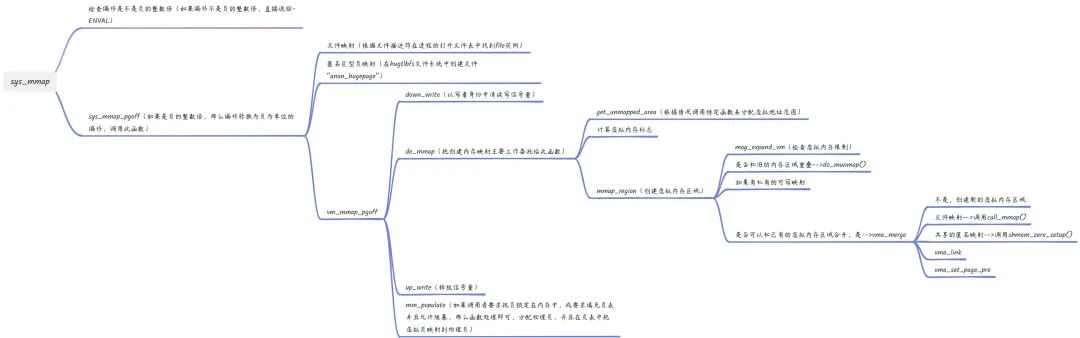
一、系统调用mmap
虚拟内存区域使用起始地址和结束地址描述,链表按起始地址递增排序。两系统调用区别:mmap指定的偏移的单位是字节,而mmap2指定的偏移的单位是页。ARM64架构实现系统调用mmap。
二、系统调用munmap
系统调用munmap用来删除内存映射,它有两个参数:起始地址和长度即可。它的主要工作委托给内核源码文件处理“mm/mmap.c”中的函数do_munmap。
vm_munmap
-->do_munmap

 -->vma = find_vma(mm,start)

    -->error = __split_vma(mm,vma,start,0)

    -->last = find_vma(mm,end)

    -->int error = __split_vma(mm,last,end,1)

    -->munlock_vma_pages_all

 -->detach_vmas_to_be_unmapped

 -->unmap_region

 -->arch_unmap

 -->remove_vma_list
vma = find_vma(mm,start);//根据起始地址找到要删除的第一个虚拟内存区域vma
error = __split_vma(mm,vma,start,0);//如果只删除虚拟内存区域vma的部分,那么分裂虚拟内存区域vma
last = find_vma(mm,end);//根据结束地址找到要删除的最后一个虚拟内存区域vma
int error = __split_vma(mm,last,end,1);//如果只删除虚拟内存区域last的一部分,那么分裂虚拟内存区域vma
munlock_vma_pages_all;//针对所有删除目标,如果虚拟内存区域被锁定在内存中(不允许换出到交换区),调用函数解除锁定
detach_vmas_to_be_unmapped;//调用此函数,把所有删除目标从进程虚拟内存区域链表和树中删除,单独组成一条临时链表
unmap_region;//调用此函数,针对所有删除目标,在进程的页表中删除映射,并且从处理器的页表缓存中删除映射
arch_unmap;//调用此函数执行处理器架构特定的处理操作
remove_vma_list;//调用此函数,删除所有目标
三、物理内存组织结构
1.体系结构
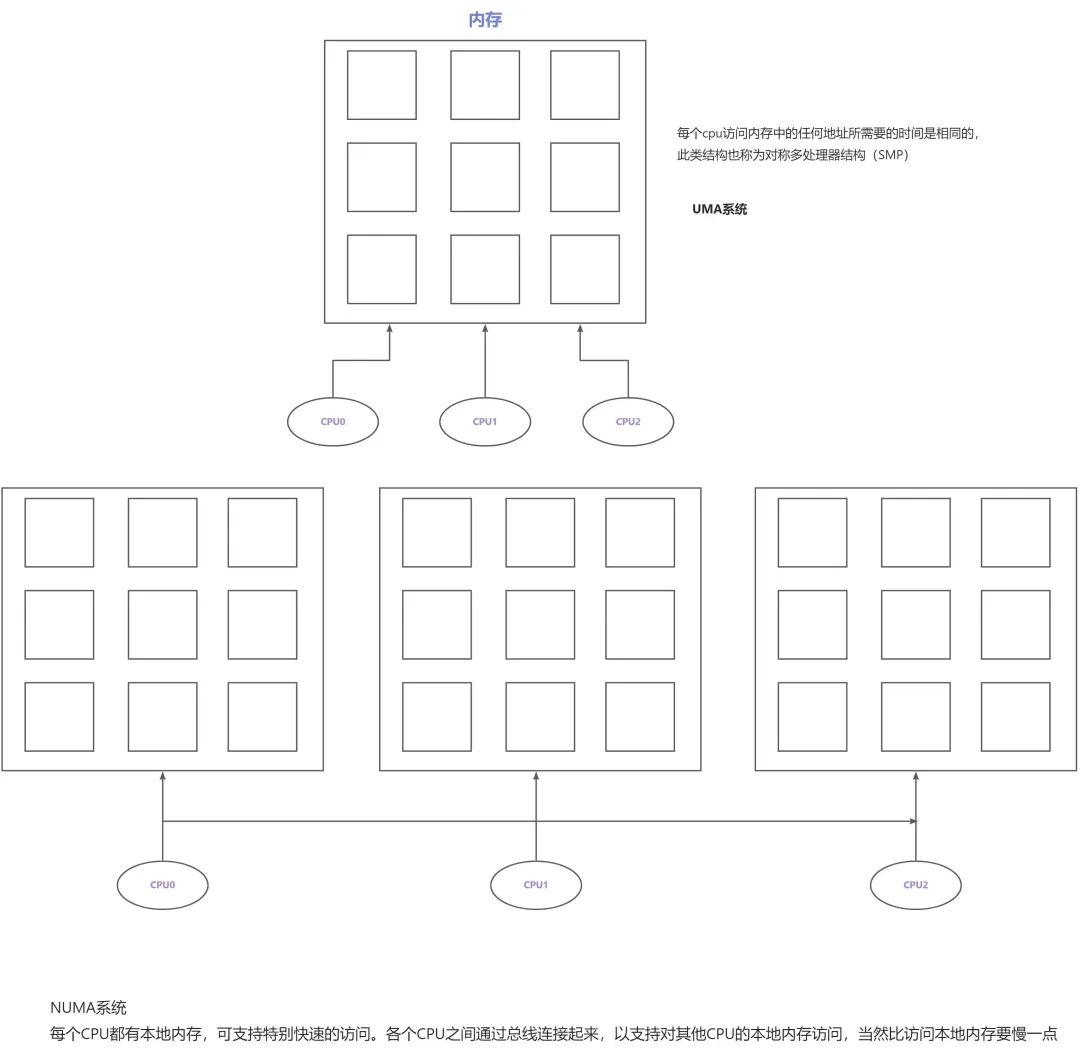
目前多处理器系统有两种体系结构:
非一致内存访问(Non-Unit Memory Access,NUMA):指内存被划分成多个内存节点的多处理器系统。访问一个内存节点花费的时间取决于处理器和内存节点的距离。
对称多处理器(Sysmmetric Muti-Processor,SMP):即一致内存访问(Uniform Memory Access,UMA),所有处理器访问内存花费的时间是相同的。
2.内存模型
内存模型是从处理器角度看到的物理内存分布,内核管理不同内存模型的方式存在差异。内存管理子系统支持3种内存模型:
平坦内存(Flat Memory):内存的物理地址空间是连续的,没有空洞。
不连续内存(Discontiguous Memory):内存的物理地址空间存在空洞,这种模型可以高效地处理空洞。
稀疏内存(Space Memory):内存物理地址空间存在空洞,如果要支持内存热插拔,只能选择稀疏内存模型。
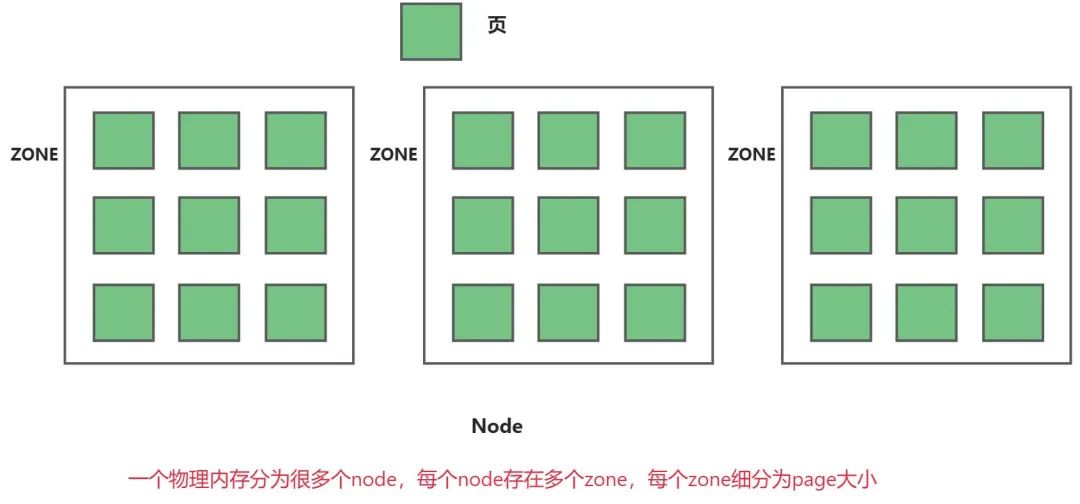
3.三级结构
内存管理子系统使用节点(node)、区域(zone)、页(page)三级结构描述物理内存。
3.1 内存节点--->分为两种情况
NUMA体系的内存节点,根据处理器和内存距离划分;
在具有不连续内存的NUMA系统中,表示比区域的级别更高的内存区域,根据物理地址是否连续,每块物理地址连续的内存是一个内存节点。
内存节点使用结构体pglist_data描述内存布局
Linux内核源码如下:
typedef struct pglist_data {
 struct zone node_zones[MAX_NR_ZONES]; // 内存区域数组
 struct zonelist node_zonelists[MAX_ZONELISTS]; // 备用区域列表
 int nr_zones; // 该节点包含内存区域数量
#ifdef CONFIG_FLAT_NODE_MEM_MAP /* means !SPARSEMEM */ // 除了稀疏内存模型以外
 struct page *node_mem_map; // 页描述符数组
#ifdef CONFIG_PAGE_EXTENSION
 struct page_ext *node_page_ext; // 页的扩展属性
#endif
#endif
#ifndef CONFIG_NO_BOOTMEM
 struct bootmem_data *bdata;
#endif
#ifdef CONFIG_MEMORY_HOTPLUG
 /*
  * Must be held any time you expect node_start_pfn, node_present_pages
  * or node_spanned_pages stay constant.  Holding this will also
  * guarantee that any pfn_valid() stays that way.
  *
  * pgdat_resize_lock() and pgdat_resize_unlock() are provided to
  * manipulate node_size_lock without checking for CONFIG_MEMORY_HOTPLUG.
  *
  * Nests above zone->lock and zone->span_seqlock
  */
 spinlock_t node_size_lock;
#endif
 unsigned long node_start_pfn; // 该节点的起始物理页号
 unsigned long node_present_pages; /* 物理页总数 */
 unsigned long node_spanned_pages; /* 物理页范围总的长度,包括空间*/

    int node_id; // 节点标识符
 wait_queue_head_t kswapd_wait;
 wait_queue_head_t pfmemalloc_wait;
 struct task_struct *kswapd; /* Protected by
        mem_hotplug_begin/end() */
 int kswapd_max_order;
 enum zone_type classzone_idx;
#ifdef CONFIG_NUMA_BALANCING
 /* Lock serializing the migrate rate limiting window */
 spinlock_t numabalancing_migrate_lock;

 /* Rate limiting time interval */
 unsigned long numabalancing_migrate_next_window;

 /* Number of pages migrated during the rate limiting time interval */
 unsigned long numabalancing_migrate_nr_pages;
#endif

#ifdef CONFIG_DEFERRED_STRUCT_PAGE_INIT
 /*
  * If memory initialisation on large machines is deferred then this
  * is the first PFN that needs to be initialised.
  */
 unsigned long first_deferred_pfn;
#endif /* CONFIG_DEFERRED_STRUCT_PAGE_INIT */
} pg_data_t;
node_mem_map此成员指向页描述符数组,每个物理页对应一个页描述符。
Node是内存管理最顶层的结构,在NUMA架构下,CPU平均划分为多个Node,每个Node有自己的内存控制器及内存插槽。CPU访问自己Node上内存速度快,而访问其他CPU所关联Node的内存速度慢。UMA被当作只一个Node的NUMA系统。
3.2 内存区域(zone)
内存节点被划分为内存区域。Linux内核源码分析:include/linux/mmzone.h
enum zone_type {
#ifdef CONFIG_ZONE_DMA
 /*
  * ZONE_DMA is used when there are devices that are not able
  * to do DMA to all of addressable memory (ZONE_NORMAL). Then we
  * carve out the portion of memory that is needed for these devices.
  * The range is arch specific.
  *
  * Some examples
  *
  * Architecture  Limit
  * ---------------------------
  * parisc, ia64, sparc <4G
  * s390   <2G
  * arm   Various
  * alpha  Unlimited or 0-16MB.
  *
  * i386, x86_64 and multiple other arches
  *    <16M.
  */
 ZONE_DMA, /*Direct Memory Access,直接内存访问。如果有些设备不能直接访问所有内存,需要使用DMA区域。ISA*/
#endif
#ifdef CONFIG_ZONE_DMA32
 /*
  * x86_64 needs two ZONE_DMAs because it supports devices that are
  * only able to do DMA to the lower 16M but also 32 bit devices that
  * can only do DMA areas below 4G.
  */
 ZONE_DMA32, /* 64位系统,如果既要支持能直接访问16MB以下内存设备,又要支持能直接访问4GB以下内存的32设备,必须使用此DMA32区域*/
#endif
 /*
  * Normal addressable memory is in ZONE_NORMAL. DMA operations can be
  * performed on pages in ZONE_NORMAL if the DMA devices support
  * transfers to all addressable memory.
  */

 /*普通内存区域:
 直接映射到内核虚拟地址空间的内存区域,又称为普通区域,又称为直接映射区域,又称为线性映射区域*/
 ZONE_NORMAL,
#ifdef CONFIG_HIGHMEM
 /*
  * A memory area that is only addressable by the kernel through
  * mapping portions into its own address space. This is for example
  * used by i386 to allow the kernel to address the memory beyond
  * 900MB. The kernel will set up special mappings (page
  * table entries on i386) for each page that the kernel needs to
  * access.
  */

 /*高端内存区域:
 此区域是32位时代的产物,内核和用户地址空间按1:3划分,
 内核地址空间只有1GB,不能把1GB以上内存直接映射到该地址*/

 ZONE_HIGHMEM,
#endif

 /*可移动区域:
 它是一个伪内存区域,用来防止内存碎片*/
 ZONE_MOVABLE,
#ifdef CONFIG_ZONE_DEVICE

 /*设备区域:
 为支持持久内存热插拔增加的内存区域,每一个内存区域用一个zone结构体来描述*/
 ZONE_DEVICE,
#endif
 __MAX_NR_ZONES

};
每个内存区域使用一个zone结构体描述,如下为主要成员:
struct zone {
/* Read-mostly fields */
/* zone watermarks, access with *_wmark_pages(zone) macros */
unsigned long watermark[NR_WMARK]; // 页分配器使用的水线
unsigned long nr_reserved_highatomic;
/*
* We don't know if the memory that we're going to allocate will be
* freeable or/and it will be released eventually, so to avoid totally
* wasting several GB of ram we must reserve some of the lower zone
* memory (otherwise we risk to run OOM on the lower zones despite
* there being tons of freeable ram on the higher zones). This array is
* recalculated at runtime if the sysctl_lowmem_reserve_ratio sysctl
* changes.
*/
long lowmem_reserve[MAX_NR_ZONES]; // 页分配器使用,当前区域保留多少页不能借给高的区域类型
#ifdef CONFIG_NUMA
int node;
#endif
/*
* The target ratio of ACTIVE_ANON to INACTIVE_ANON pages on
* this zone's LRU. Maintained by the pageout code.
*/
unsigned int inactive_ratio;
struct pglist_data *zone_pgdat; // 指向内存节点的pglist_data实例
struct per_cpu_pageset __percpu *pageset; // 每处理页集合
/*
* This is a per-zone reserve of pages that should not be
* considered dirtyable memory.
*/
unsigned long dirty_balance_reserve;
#ifndef CONFIG_SPARSEMEM
/*
* Flags for a pageblock_nr_pages block. See pageblock-flags.h.
* In SPARSEMEM, this map is stored in struct mem_section
*/
unsigned long *pageblock_flags;
#endif /* CONFIG_SPARSEMEM */
#ifdef CONFIG_NUMA
/*
* zone reclaim becomes active if more unmapped pages exist.
*/
unsigned long min_unmapped_pages;
unsigned long min_slab_pages;
#endif /* CONFIG_NUMA */
/* zone_start_pfn == zone_start_paddr >> PAGE_SHIFT */
unsigned long zone_start_pfn; // 当前区域的起始物理页号
/*
* spanned_pages is the total pages spanned by the zone, including
* holes, which is calculated as:
* spanned_pages = zone_end_pfn - zone_start_pfn;
*
* present_pages is physical pages existing within the zone, which
* is calculated as:
* present_pages = spanned_pages - absent_pages(pages in holes);
*
* managed_pages is present pages managed by the buddy system, which
* is calculated as (reserved_pages includes pages allocated by the
* bootmem allocator):
* managed_pages = present_pages - reserved_pages;
*
* So present_pages may be used by memory hotplug or memory power
* management logic to figure out unmanaged pages by checking
* (present_pages - managed_pages). And managed_pages should be used
* by page allocator and vm scanner to calculate all kinds of watermarks
* and thresholds.
*
* Locking rules:
*
* zone_start_pfn and spanned_pages are protected by span_seqlock.
* It is a seqlock because it has to be read outside of zone->lock,
* and it is done in the main allocator path. But, it is written
* quite infrequently.
*
* The span_seq lock is declared along with zone->lock because it is
* frequently read in proximity to zone->lock. It's good to
* give them a chance of being in the same cacheline.
*
* Write access to present_pages at runtime should be protected by
* mem_hotplug_begin/end(). Any reader who can't tolerant drift of
* present_pages should get_online_mems() to get a stable value.
*
* Read access to managed_pages should be safe because it's unsigned
* long. Write access to zone->managed_pages and totalram_pages are
* protected by managed_page_count_lock at runtime. Idealy only
* adjust_managed_page_count() should be used instead of directly
* touching zone->managed_pages and totalram_pages.
*/
unsigned long managed_pages; // 伙伴分配器管理的物理页的数量
unsigned long spanned_pages; // 当前区域跨越的总页数,包括空洞
unsigned long present_pages; // 当前区域存在的物理页的数量,不包括空洞
const char *name; // 区域名称
#ifdef CONFIG_MEMORY_ISOLATION
/*
* Number of isolated pageblock. It is used to solve incorrect
* freepage counting problem due to racy retrieving migratetype
* of pageblock. Protected by zone->lock.
*/
unsigned long nr_isolate_pageblock;
#endif
#ifdef CONFIG_MEMORY_HOTPLUG
/* see spanned/present_pages for more description */
seqlock_t span_seqlock;
#endif
/*
* wait_table -- the array holding the hash table
* wait_table_hash_nr_entries -- the size of the hash table array
* wait_table_bits -- wait_table_size == (1 << wait_table_bits)
*
* The purpose of all these is to keep track of the people
* waiting for a page to become available and make them
* runnable again when possible. The trouble is that this
* consumes a lot of space, especially when so few things
* wait on pages at a given time. So instead of using
* per-page waitqueues, we use a waitqueue hash table.
*
* The bucket discipline is to sleep on the same queue when
* colliding and wake all in that wait queue when removing.
* When something wakes, it must check to be sure its page is
* truly available, a la thundering herd. The cost of a
* collision is great, but given the expected load of the
* table, they should be so rare as to be outweighed by the
* benefits from the saved space.
*
* __wait_on_page_locked() and unlock_page() in mm/filemap.c, are the
* primary users of these fields, and in mm/page_alloc.c
* free_area_init_core() performs the initialization of them.
*/
wait_queue_head_t *wait_table;
unsigned long wait_table_hash_nr_entries;
unsigned long wait_table_bits;
ZONE_PADDING(_pad1_)
/* free areas of different sizes */
struct free_area free_area[MAX_ORDER]; // 不同长度的空间区域
/* zone flags, see below */
unsigned long flags;
/* Write-intensive fields used from the page allocator */
spinlock_t lock;
ZONE_PADDING(_pad2_)
/* Write-intensive fields used by page reclaim */
/* Fields commonly accessed by the page reclaim scanner */
spinlock_t lru_lock;
struct lruvec lruvec;
/* Evictions & activations on the inactive file list */
atomic_long_t inactive_age;
/*
* When free pages are below this point, additional steps are taken
* when reading the number of free pages to avoid per-cpu counter
* drift allowing watermarks to be breached
*/
unsigned long percpu_drift_mark;
#if defined CONFIG_COMPACTION || defined CONFIG_CMA
/* pfn where compaction free scanner should start */
unsigned long compact_cached_free_pfn;
/* pfn where async and sync compaction migration scanner should start */
unsigned long compact_cached_migrate_pfn[2];
#endif
#ifdef CONFIG_COMPACTION
/*
* On compaction failure, 1<
3.3 物理页
页是内存管理当中最小单位,页面中的内存其物理地址是连续的,每个物理页由struct page描述。为了节省内存,struct page是个联合体。
页,又称为页帧,在内核当中,内存管理单元MMU(负责虚拟地址和物理地址转换的硬件)是把物理页page作为内存管理的基本单位。体系结构不同,支持的页大小也不同。(32位体系结构支持4KB的页、64位体系结构支持8KB的页、MIPS64架构体系支持16KB的页)
审核编辑:汤梓红
-
带你了解Linux内核体系结构2018-08-27 0
-
Linux内核结构详解2019-07-11 0
-
如何避免Linux的物理内存碎片化2018-05-01 5461
-
Linux内核地址映射模型与Linux内核高端内存详解2018-05-08 3457
-
Linux0.11-内存组织和进程结构2019-05-15 1116
-
一文解析Linux内存系统2020-09-01 2443
-
STM32MP157 Linux系统移植开发篇7:Linux内核目录结构详解2021-12-17 580
-
一文详解Linux内核源码组织结构2022-05-10 5764
-
Linux内核的内存管理详解2023-08-31 788
-
Linux的内存管理是什么,Linux的内存管理详解2022-05-11 6057
-
走进Linux内存系统探寻内存管理的机制和奥秘2023-01-05 1630
-
Linux内核内存泄漏怎么办2023-07-04 824
-
Linux内存相关知识科普2023-07-25 728
-
Linux内核的物理内存组织结构详解2023-08-21 572
-
Linux内核内存管理之内核非连续物理内存分配2024-02-23 972
全部0条评论

快来发表一下你的评论吧 !
